
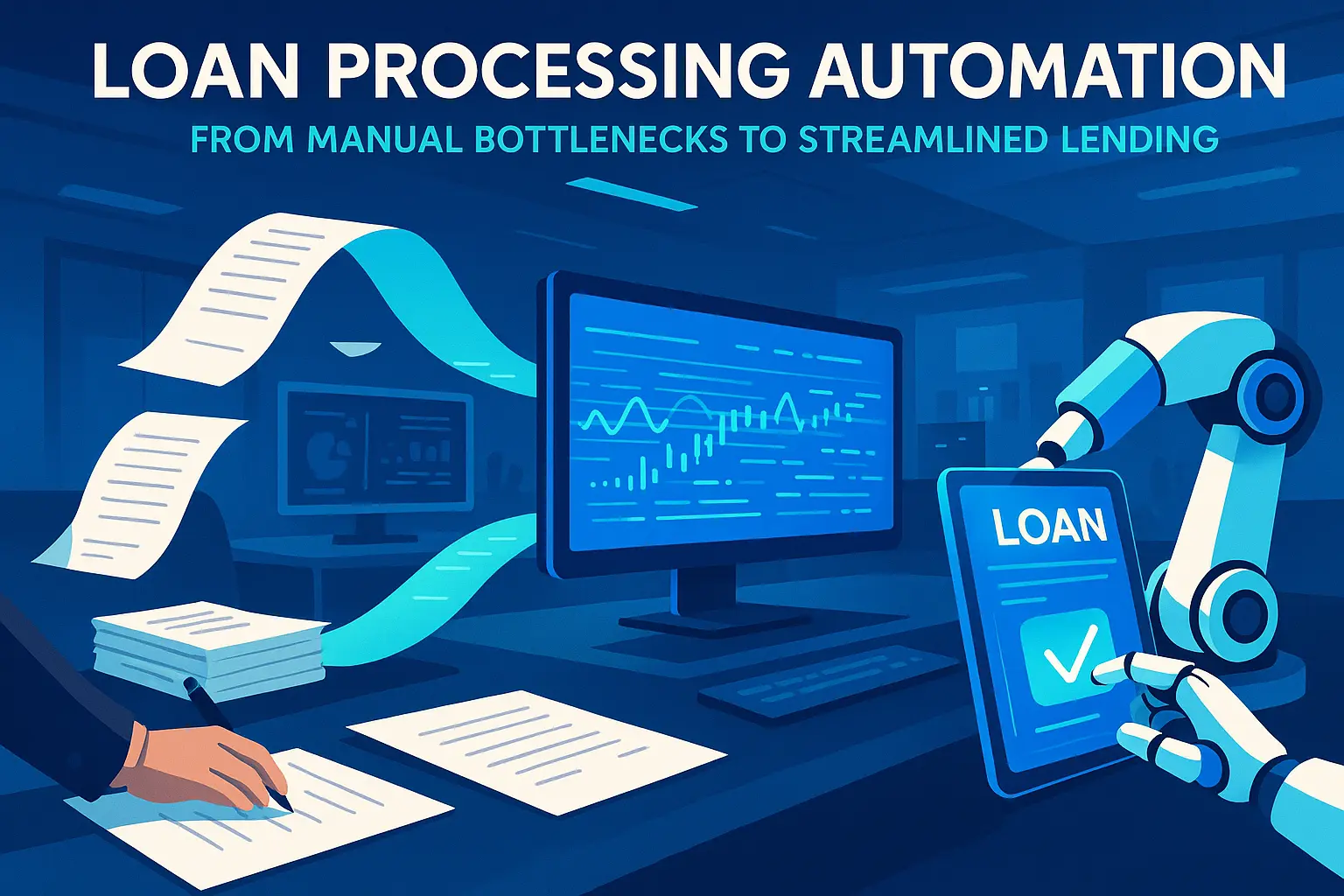
Loan Processing Automation: From Manual Bottlenecks to Streamlined Lending
Sofia Rangoni

Dec 1, 2025
What Is Loan Processing Automation?
Loan processing automation replaces slow, error-prone manual tasks with technology-driven workflows. Instead of chasing paperwork, copying data between documents, and relying on phone calls or email chains, automation allows every step of the lending journey to advance seamlessly and accurately, often requiring little to no human intervention for routine actions.
How Automated Loan Processing Works
An automated loan processing system serves as a digital conductor, orchestrating the flow of information from application to approval. Once a borrower applies, whether online or in-branch, the system captures the details, retrieves documents, checks for completeness, and even cross-verifies data using integrated databases. Next, built-in logic engines assess eligibility and risk based on institution-specific rules. Updates and requests for missing information can be triggered automatically, keeping both staff and borrowers in sync.
Traditional vs Automated Loan Processing
Traditionally, loan officers were mired in paperwork: manually collecting documents, re-entering data into multiple systems, conducting credit pulls by hand, and waiting days (or weeks) for verification responses. This approach opens the door to delays, mistakes, and repeated requests for information, frustrating both lender and applicant.
In contrast, automated loan processing cuts out repetition and bottlenecks. Verifications, calculations, and document checks run in the background, and notifications prompt action only when exceptions arise. As a result, routine loans can be approved in hours instead of days, and human expertise can focus on complex or exceptional cases.
To understand the impact of automation, it’s useful to look at the specific stages of the loan journey that benefit most from this technological leap.
Core Steps Automated in the Loan Lifecycle
Loan Origination
The loan journey begins with origination, often a painful maze of forms and initial eligibility checks. Automation simplifies this entry point. Prospective borrowers can apply online, submit their essential data, and receive instant feedback on their eligibility. Systems flag incomplete details on the spot, shaving days off the initial screening.
Document Collection and Verification
No more chasing paper trails or correcting endless typos. Modern platforms prompt applicants for required documents, then use automated tools to capture, classify, and extract critical data points. Real-time validations scan for inconsistencies, expired documents, and even signs of tampering, reducing manual review demands.
Credit Assessment and Underwriting
Automation revolutionizes credit analysis by instantly fetching credit reports, income statements, and compounding this information with proprietary risk models. Underwriting no longer fades into a black box: algorithms generate clear, auditable trails for each decision. Human intervention is only called for in edge cases.
Decision and Approval
Once underwriting is complete, decision engines evaluate all relevant factors, such as credit scores, debt ratios, and application data, to issue approvals or rejections within seconds. Borrowers experience unprecedented transparency, as status updates are triggered automatically at every stage.
Disbursement and Onboarding
After approval, automation facilitates the prompt disbursement of funds. Smart integrations with banking systems move money securely, notify applicants, and launch onboarding. Customers receive step-by-step instructions for next actions, and all compliance documentation is generated automatically, ready for a digital signature.
Each of these automated steps is powered by specific technologies that work together behind the curtain to unlock speed, precision, and security. Next, we'll explore the tools making this seamless workflow possible and how they fit into today's lending landscape.
Key Technologies Driving Loan Processing Automation
Optical Character Recognition (OCR)
OCR technology extracts text from scanned documents, such as pay stubs, tax returns, and identification forms. Where staff once retyped or manually checked endless paperwork, modern OCR identifies key fields and transforms them into structured data, drastically speeding up validation. Advanced OCR platforms even recognize handwriting and detect errors, minimizing input mistakes that clog up the process.
Picture a stack of loan application forms instantly processed with a scanner and OCR: data is indexed and routed to the next stage without delay.
Robotic Process Automation (RPA)
RPA acts like a digital workforce, automatically following rule-based instructions to handle repetitive tasks. For lending teams, this means bots move applications between systems, update customer records, and trigger verification steps, both overnight and on weekends. Instead of manually copying information or clicking through screens, RPA delivers 24/7 consistency and helps staff focus on exceptions.
Artificial Intelligence and Machine Learning
AI and machine learning analyse thousands of data points, from bank statements to social footprints, to flag inconsistencies, rate risk, or recommend approval. These models learn from real-world applications and continually improve over time, helping lenders find qualified borrowers faster and detect fraud attempts earlier. AI also powers chatbots and recommendation engines to keep borrowers informed about their application status in real time.
API Integrations with Core Banking
APIs bridge the gap between loan processing software and core banking systems. Secure integrations fetch and validate account information, automate credit pulls, and instantly update loan status throughout the organisation. APIs eliminate data silos: every stage, from origination to disbursement, communicates smoothly, cutting out delays that once required emails or phone calls.
Together, these technologies enable lenders to overcome manual bottlenecks to deliver smarter, smoother lending experiences. Next, let’s see how these tools transform different types of loan scenarios with hands-on examples from the real world.
Automation Use Cases: Real-World Examples
Consumer Loans
A regional credit union introduced automation to speed up personal loan approvals. Automated workflows pre-fill application fields, run real-time credit checks, and verify applicant details against external databases. As a result, applicants often receive decisions within minutes, even outside traditional banking hours. Previously, approvals could be delayed for days due to manual data entry and verification.
Small Business Lending
A community bank leveraged robotic process automation for its small business loans. Automated bots gather business registration documents, check tax filings via government APIs, and flag any missing paperwork. Underwriting algorithms score applications based on cash flow and account history. This trimmed weeks from approval timelines, a crucial difference for business owners seeking quick access to funds for inventory or payroll.
Auto and Indirect Loans
An auto lender digitised its indirect loan process with straight-through processing. Car dealerships upload buyer documents, which are instantly classified by optical character recognition and verified for completeness. Automated rules assess loan-to-value ratios, calculate payment schedules, and generate digital contracts for e-signature. Dealerships can finalise sales on the spot without waiting for next-day bank responses.
Mortgage and Real Estate Loans
A mortgage provider replaced dozens of manual steps with AI-driven automation. Income and employment data are extracted from payroll providers, property details are pulled from county records, and compliance checks ensure every file adheres to changing lending regulations. Borrowers can track progress in real time, from application to closing, leading to fewer surprises and less back-and-forth for everyone involved.
These examples highlight how automation eliminates the typical roadblocks of data entry, manual review, and approval delays. Let’s now explore the tangible impact these innovations have on both lenders and borrowers.
Benefits for Lenders and Borrowers
Faster Loan Turnaround Times
Automation slashes the wait. Tasks that once took days, verifying documents, checking credit, and compiling data, now happen in hours or even minutes. This speed means more approved loans, fewer abandoned applications, and opportunities seized before competitors catch up.
Improved Accuracy and Compliance
No more missing documents or skipped steps. Automated loan processing ensures every item on the checklist gets addressed. Rule engines and validation routines flag inconsistencies or missing info instantly, reducing manual errors and helping lenders nail regulatory requirements without digging through spreadsheets and folders.
Reduced Operational Costs
Loan processing bots don’t pull overtime. Automation means fewer staff hours needed for data entry, file chasing, and double-checking figures. Lenders can scale up without hiring in droves, redirecting their teams to focus on complex cases or customer service rather than on repetitive administrative tasks.
Enhanced Customer Experience
Borrowers notice the difference when a process goes from drawn-out and mysterious to fast and transparent. Real-time updates, e-signature links, and instant decisions keep frustration at bay. Automation even makes it possible to apply for and track a loan 24/7, without waiting for bank hours or call-backs.
The shift to automated loan processing redefines what both lenders and borrowers expect from financial transactions. Of course, introducing automation into the lending world isn’t entirely without its hiccups. There are hurdles to clear for a smooth transition, especially when new technology meets established ways of working.
Common Challenges When Automating Loan Processing
Automating loan processing isn’t a magic button. It comes with tricky terrain, from tangled legacy systems to evolving legal requirements that affect every click and query. Here are a few of the most persistent pain points lenders encounter when navigating the shift from paper and spreadsheets to intelligent workflows.
Managing Data Security and Privacy
Loan processing relies on a goldmine of sensitive personal and financial data. Automating these workflows requires robust security, but risks multiply as data moves between cloud servers, third-party services, and internal databases. A missed encryption protocol or poorly managed access rights can have costly consequences. Banks must continually stay ahead of cyber threats while ensuring privacy for every applicant.
Adapting to Evolving Regulations
Financial rules rarely stand still. Building automation that complies with today’s requirements is only half the battle; ongoing changes, such as updates to anti-money laundering directives or new data residency mandates, can necessitate hasty software tweaks or retraining. Rigid automation scripts often break when faced with regulatory change, making adaptability an essential technical trait.
Ensuring Fairness in Automated Decisions
Algorithm-driven decisioning promises objective lending, but only if the underlying models are transparent and free from bias. Poorly designed automations can unintentionally reinforce historical inequalities, flagging some borrowers or communities for extra scrutiny. Lenders must routinely audit algorithms to uncover and correct hidden biases, while maintaining explanation trails that can satisfy both applicants and regulators.
Legacy System Integration Issues
Most banks and credit unions aren’t starting from scratch; they're saddled with legacy software built for a slower, analogue age. Modern automation must bridge these decades-old infrastructures with slick, API-driven tools. Integration projects often reveal hidden data silos, proprietary formats, and undocumented quirks, turning a simple upgrade into a months-long technical puzzle.
Recognising these hurdles is the first step to overcoming them. As you evaluate potential solutions, knowing which features and approaches help sidestep these pain points can make your transition to automation smoother and less disruptive.
Choosing the Right Loan Automation Solution
Key Features to Consider
Your choice of automation platform shapes the speed and reliability of your entire loan process, so it pays to dig beneath the surface of bold marketing claims. Look for solutions that offer end-to-end automation, from application intake to post-disbursement servicing, rather than just isolated modules.
Prioritise platforms with robust data capture capabilities, such as intelligent OCR that can parse both scanned documents and digital uploads without frequent errors. APIs should be flexible, enabling seamless connections to credit bureaus, bank cores, and third-party verification services. In today’s regulatory landscape, compliance management must be baked in, including automated audit trails and custom rules for regional variations.
User experience matters, too. Seek out solutions with intuitive dashboards that give lending teams clear visibility into application statuses, bottlenecks, and compliance alerts in real time. Automation is supposed to save time, not create a labyrinthine new system to learn.
Steps to a Successful Implementation
Start with a clear map of your current loan workflows. Identify where delays or errors most often occur; those pain points should be the first targets for automation. Involve frontline staff when evaluating platforms; their day-to-day insights will reveal whether a potential solution will actually solve real problems.
Run a pilot phase with a small group of users and real loan files. Measure both speed-to-decision and error rates, then adapt your rollout based on early findings. Don’t skip thorough data migration testing: legacy data inconsistencies can torpedo even the best-planned upgrades. Lastly, build a continuous feedback loop, plan for regular check-ins after deployment to catch missed opportunities and further streamline new pain points as they appear.
With the right solution chosen and implementation underway, it’s time to look ahead at the trends shaking up this fast-evolving field and uncover the next wave of possibilities for automated loan processing.
The Future of Loan Processing Automation
Trends to Watch
The lines between human and digital intelligence are rapidly disappearing in lending. Over the next few years, expect to see fully digital loan journeys powered by self-service portals, smart chatbots guiding applicants, and real-time feedback replacing radio-silence waiting periods. No more endless paperwork or phone tag, the next generation of automation will quietly stitch together everything from credit scoring to e-signatures, making "10-minute loan approvals" a standard rather than a campaign slogan.
Blockchain is poised to play a pivotal role in loan processing, with transparent loan histories, tamper-proof records, and borrower credentials living on secure, distributed ledgers. Meanwhile, advances in cloud-native APIs and open banking frameworks are unlocking lender interoperability. Instead of siloed systems, lenders can leverage a plug-and-play ecosystem, which boosts service speed and broadens access for previously underserved applicants.
Opportunities for Further Innovation
Innovation will likely centre around hyper-personalisation. AI models can already factor dozens of subtle variables that traditional scoring overlooked, such as alternative credit data and behavioural analytics. Soon, predictive insights could craft unique loan offers tailored to a borrower’s digital footprint, occupation, and even life events. This means less guesswork in approvals, lower risk for lenders, and fairer outcomes for borrowers.
Additionally, automation is set to drive financial inclusion globally. Mobile-first, cloud-based platforms enable loan processing in markets where traditional banks have never reached. As lending migrates online, underbanked and unbanked users suddenly gain access to capital for the first time, often in minutes, without ever having to enter a branch.
With these forces converging, lenders can’t afford to stand still. The ability to adapt and keep pace with intelligent automation will determine who thrives in tomorrow’s lending landscape. As we look ahead, it’s crucial to evaluate how today’s solutions measure up to these emerging possibilities, and what practical steps you can take to unlock their full potential.
Frequently Asked Questions
How quickly can a bank or lender implement loan processing automation?
Implementation timelines depend on the size of the lending institution and its existing systems. Small to midsize lenders often see results within a few months, especially if they use cloud-based solutions with pre-built integrations. Larger banks with complex legacy systems may require more custom work; however, pilot projects can still be launched relatively quickly.
Does automation reduce jobs in loan operations?
Automation handles repetitive, rule-based tasks, such as data entry and document verification. This frees up lending teams to work on customer service, complex cases, or relationship management areas where human expertise and empathy are essential. Roles may shift, but people remain a vital part of the process.
How secure is automated loan processing?
Reputable automation platforms use encryption, access controls, and detailed audit trails to protect sensitive borrower information. They’re often designed to comply with financial regulations such as GDPR or GLBA, which helps lenders maintain strict data privacy practices.
Can automation adapt to changes in lending regulations?
Modern platforms are designed to stay current. Rule engines and automated workflows can be updated as laws change. This minimises compliance risk and reduces the manual effort needed to keep lending operations up to date.
Will borrowers notice that their applications are being processed by automated systems?
Most borrowers simply notice that the process is faster and communication is more consistent. Automation works behind the scenes, so customers benefit indirectly from more efficient service, quicker approvals, fewer errors, and easy document uploads.






💚 Don’t get left behind
Ready To Join The Circular Movement?
United for a smarter shopping experience and a better planet