
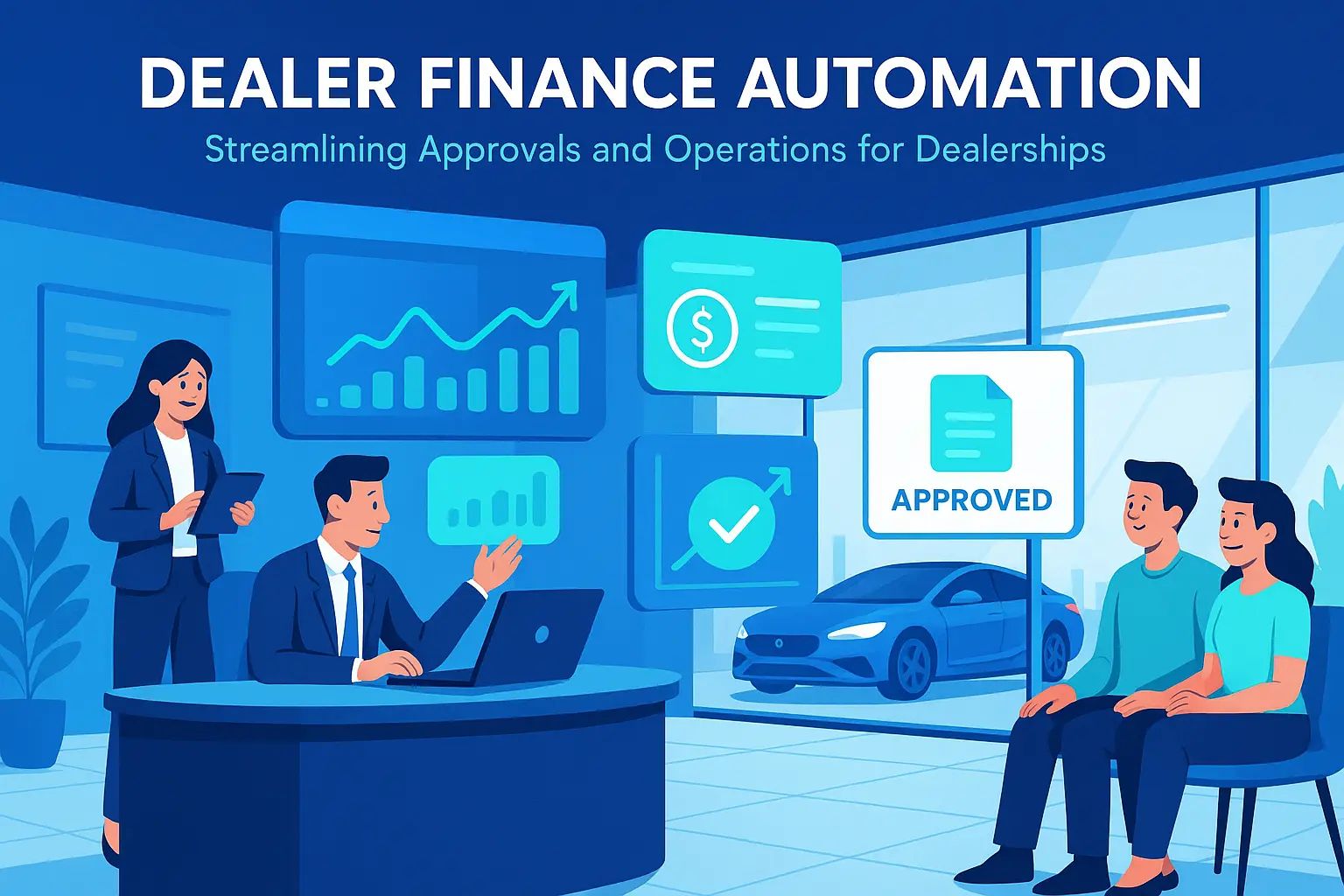
Dealer Finance Automation: Streamlining Approvals and Operations for Dealerships
Sofia Rangoni

Feb 17, 2026
What Is Dealer Finance Automation?
Dealer finance automation is the use of digital tools and intelligent workflows to handle auto dealership financing tasks that used to eat up hours, think credit checks, approvals, paperwork, and communication between dealership, lenders, and customers. Instead of sifting through stacks of forms or manually entering data, much of the routine hustle now runs on autopilot.
Core Components and Technologies
At its heart, dealer finance automation brings together a handful of technologies. Digital loan applications let customers apply online or at the dealership, while workflow engines instantly route documents and tasks to the right person. Credit decisioning platforms, often powered by AI, review applications and make preliminary lending calls in seconds, not days. Electronic document management means all records, forms, and signatures live securely in the cloud, ready for audit or retrieval.
Dealers also benefit from integrations that connect their systems with finance sources, CRMs, and OEM portals. These connections eliminate endless re-keying and provide a single, seamless view of every deal’s progress.
How Automation Differs from Traditional Finance Processing
Traditional dealer finance workflows involve a lot of handoffs and paperwork. Staff collect customer documents, call lenders, fax or email contracts, and wait for approvals. Every misstep or missing item slows things down, often leading to customer frustration and delayed funding.
With automation, the process changes dramatically. Instead of chasing paperwork or cross-checking application data, staff monitor digital dashboards that flag only the exceptions needing attention. Routine deals move from application to approval in minutes, and communication between all parties (dealers, lenders, and buyers) becomes faster and simpler. Automation cuts back on errors, reduces back-and-forth, and delivers a smoother path from sale to funding for everyone involved.
Having explored what dealer finance automation really means and how it stands apart from the manual status quo, let’s see how these digital tools are reshaping day-to-day dealership workflows, and why frontline teams are noticing the difference.
How Automation Transforms Dealer Finance Workflows
Digital Application Intake and Verification
Gone are the days of paper-heavy submissions and endless data entry. Today’s automation tools collect financing applications directly from customers, instantly scanning them for completeness and authenticity. Personal details and financial data are checked against internal databases and third-party sources, flagging inconsistencies or missing information before they cause bottlenecks. This not only simplifies the process for customers, but spares dealership staff from sifting through stacks of paperwork or chasing down small errors by phone or email.
Automated Loan Approval and Funding
Once an application is verified, automation continues by evaluating creditworthiness and matching applicants with loan options, sometimes within seconds. Decision engines analyze credit scores, debt-to-income ratios, and lender criteria, presenting pre-approved offers without requiring multiple manual reviews. Funding workflows are synchronized so that, once terms are accepted, contracts are generated and routed instantly. This slashes approval times, helping customers secure vehicles faster and letting dealerships close deals before buyers think twice.
Real-Time Compliance and Document Management
Compliance is non-negotiable in dealership finance, but it doesn’t have to slow things down. Automated systems track document versions, require e-signatures on regulated forms, and keep an audit-ready record of actions taken throughout each deal. The latest compliance rules, from privacy policies to regional disclosures, update in the background, ensuring nothing is missed regardless of changing regulations or staff turnover. With every document stored digitally and securely, audits become far less stressful and errors much less likely.
All these advances create a seamless, connected experience that benefits everyone in the dealership. But how does this efficiency translate into direct value for your business? Let’s explore the concrete benefits next.
Key Benefits for Dealerships
Faster Deal Closings and Cash Flow
Speed can make or break a sale. Dealer finance automation accelerates the approval timeline, from application to funding, so deals rarely stall waiting for paperwork or manual reviews. With instant information checks and automated decisioning, dealerships see funds clear faster and vehicles move off the lot without unnecessary delays.
Reduced Manual Errors and Fraud Risk
Manual processes are prone to mistakes, whether it’s data entry errors or overlooked discrepancies in documents. Automation validates data in real time, reducing costly mistakes and catching signs of fraud before they impact the bottom line. The result is peace of mind and fewer deal setbacks caused by human error.
Elevated Customer and Staff Experience
Automated finance systems simplify life for both buyers and dealership teams. Customers experience faster approvals and less paperwork, leading to higher satisfaction scores. Staff can focus on building relationships and closing more deals rather than shuffling paperwork or reconciling files, which improves morale and efficiency throughout the showroom.
With these key advantages, dealerships can move confidently into the future, armed with tools designed to keep operations nimble and deals flowing. Next, let’s explore what to look for when choosing an automation solution to fit your unique needs.
Features to Look For in Dealer Finance Automation Solutions
Integration with DMS and OEM Platforms
Seamless sync with your dealership management system (DMS) and manufacturer (OEM) platforms is non-negotiable. Integration ensures that sales and finance data flows instantly, eliminating double entry and reducing the risk of mismatched information. With real-time connections, you can push deals forward without jumping between systems or delaying approvals. Look for APIs or direct plug-ins that work with your current tech stack, saving your team hours of rekeying and reconciliation work.
AI-Powered Credit Decisioning
Speed and accuracy are the lifeblood of finance approval. Solutions that use artificial intelligence analyze credit applications and supporting documents in seconds, evaluating not just credit scores, but also alternative data, patterns, and risk indicators. This enables faster, smarter decisions while minimizing bias. Advanced platforms can even recommend the best lender fit for each customer, improving approval rates and maximizing dealership profitability.
Mobile and e-Signature Capabilities
Today’s buyers expect digital convenience. Mobile-ready finance tools let staff work deals anywhere on the lot, upload documents quickly, and keep customers updated on the spot. Secure e-signature functionality adds another layer of convenience, allowing buyers to sign from their device, speeding up deal closures and keeping paperwork organized and audit-ready. These features shrink bottlenecks and build trust with tech-savvy customers.
Choosing a finance automation solution with these features isn't just about technology, it's about unlocking new levels of speed, reliability, and customer satisfaction. Next, let’s see how these features play out in dealerships that have already automated their finance operations.
Real-World Impact: Case Studies from Dealerships Using Automation
When it comes to dealership operations, nothing speaks louder than results. Across the country, dealerships of all sizes have embraced finance automation and encountered dramatic, measurable improvements.
Consider a midsize dealership in Texas that struggled with long loan approval times and paperwork bottlenecks. After adopting automated credit decisioning and digital document management, average deal closure time shrank from four hours to just over an hour. This change not only delighted buyers but also allowed the finance team to process more deals per day, creating a tangible boost in monthly revenue.
On the West Coast, a multi-location auto group implemented a unified automation solution for its finance operations. Before automation, coordinating compliance documents across locations was chaotic, leading to costly delays. By centralizing workflows and introducing real-time document verification, the dealerships reported a 98% reduction in compliance errors and a 60% drop in missed deal packets, safeguarding profitability and keeping regulators happy.
For a family-owned dealership in the Midwest, automated finance tools became a game-changer for customer experience. With mobile applications and instant verification, buyers could complete most paperwork from their phones or in the showroom. Surveys showed a 40% increase in customer satisfaction scores post-implementation, proof that automation can forge stronger relationships along with operational gains.
Each of these dealerships saw setbacks and learning curves during their transitions, but they stress that careful planning and team involvement made all the difference. As you consider the practical steps to introduce automation, insights from their journeys can illuminate your own roadmap to a smoother, more productive finance operation.
Best Practices for Successful Implementation
Staff Training and Change Management
Introducing finance automation isn’t just about new software; it’s about helping people adapt. Start with short, practical training sessions focused on everyday tasks. Give everyone the chance to explore the new system, preferably with sandbox demos that let users test features and workflows without pressure. Assign “automation champions” at your dealership who can help their peers navigate changes and answer questions in real time. Recognize and celebrate early wins to build positive momentum.
Ensuring Data Security and Compliance
Automation moves sensitive financial data faster than ever, so airtight protection is essential. Work closely with your vendor to conduct a security review, this should include multi-factor authentication, role-based access, and audit trails that record all actions within the platform. Confirm the solution stays updated with current lending regulations and consumer privacy laws. Run regular mock audits to pinpoint weak spots before an actual problem arises.
Ongoing Performance Monitoring
Don’t consider the transition done after launch. Set up dashboards to track key metrics: application turnaround times, funding speed, error rates, and compliance checks. Hold regular check-ins, weekly at first, then monthly, to review what’s running smoothly and what needs adjusting. Seek feedback from both your finance team and customers to spot bottlenecks or confusing steps. Be ready to tweak workflows to keep approvals and operations sharp.
With the right foundation, dealerships can fully unlock the promise of automation, yet technology keeps evolving. Let’s explore what’s on the horizon and how forward-thinking dealers are preparing for the next leap in finance automation.
What’s Next for Dealer Finance Automation?
AI and Predictive Analytics in Financing
The next leap for dealer finance automation is already in motion, artificial intelligence is rewriting the playbook. Imagine lenders instantly evaluating risk, not just from a credit score, but from hundreds of data points spanning digital footprints, market trends, and payment behaviors. Predictive analytics tools are flagging likely approvals, surfacing fraud red flags, and identifying customized offers before a customer even enters the showroom. Dealers who harness these tools can not only accelerate funding decisions but can also serve up financing options that are nearly tailor-made for each buyer.
Digital Retailing and the Connected Dealership
Finance automation is also becoming the backbone of a seamless online-to-in-store journey. As shoppers expect more of their car-buying journey to happen from their phones or laptops, automated finance tools are bridging the gap between your digital storefront and the deal desk. Integration with CRMs, inventory, and even marketing platforms means that when a customer gets pre-approved online, the finance offer, vehicle details, and even trade-in values travel fluidly to the desk manager and back to the buyer with no re-keying, no confusion, and minimal delays. This interconnected experience positions dealerships to meet rising expectations for convenience and transparency at every step.
As automation continues to reshape the landscape, the road ahead calls for dealerships to think beyond technology and refine the human experience woven throughout the financing process. In the next section, we’ll look at some of the top questions and concerns dealerships face as they bring finance automation deeper into their operations.
FAQs on Dealer Finance Automation
How does dealer finance automation improve approval times?
Instead of handling stacks of forms or waiting days for emails to travel back and forth, automation platforms process credit data instantly. Credit pulls, document validation, and lender decisions are carried out in seconds, so approvals often happen while customers are still in the showroom.
Will automation replace F&I managers?
No, automation handles repetitive work but enhances, not replaces, the F&I manager’s role. With less paperwork and data entry, F&I teams can focus on guiding clients, personalized upselling, and compliance checks that require a human touch.
Is dealer finance automation secure?
Reputable solutions use bank-level encryption, secure access controls, and regular third-party audits to protect sensitive customer and dealership data. Many systems also have built-in compliance monitoring for changing industry regulations.
Can automation connect with our current DMS or CRM?
Most leading automation platforms are designed to integrate with common dealership systems, letting you sync applications, contracts, and updates across platforms without duplicate entries. Always check integration capabilities before making a choice.
Does automation work for both retail and lease deals?
Yes. Modern dealer finance automation platforms accommodate different deal structures, including retail, lease, used, and new vehicle transactions, making the process consistent regardless of what you sell.






💚 Don’t get left behind
Ready To Join The Circular Movement?
United for a smarter shopping experience and a better planet